
For exporters of fruit concentrates, fruit purees and other industrial food ingredients, packaging is no longer only a question of protecting the product during transportation. It is becoming an increasingly important part of regulatory compliance, sustainability strategy and supplier qualification.
This is particularly relevant for companies supplying the European Union.
The EU Packaging and Packaging Waste Regulation, commonly known as PPWR, entered into force on 11 February 2025 and generally starts applying from 12 August 2026. The Regulation covers packaging placed on the EU market regardless of its material or origin and introduces requirements related to packaging design, recyclability, waste prevention and other sustainability criteria.
For B2B fruit ingredient suppliers, this means packaging decisions deserve much more attention during quotation and technical approval.
Why this matters for fruit concentrates and purees
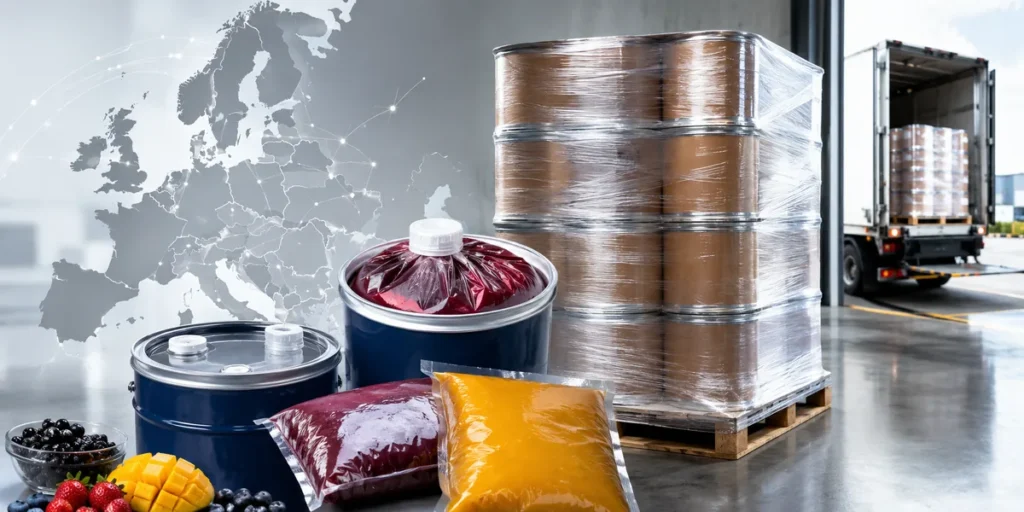
Industrial ingredients are commonly transported in formats such as aseptic bags, steel drums, cartons, pallets and protective wrapping.
A shipment may therefore contain several packaging components, each with a different function.
The food-contact bag protects the ingredient directly. The drum provides mechanical protection. Pallets and wrapping help secure the product during warehouse handling and international transportation.
From a procurement perspective, buyers are increasingly likely to ask not only:
“What is the net weight per drum?”
but also:
“What materials are used in the packaging, and are they suitable for our destination market?”
The PPWR aims, among other things, to improve packaging recyclability and reduce unnecessary packaging. The European Commission states that the new framework is intended to make packaging placed on the EU market more circular and progressively improve its recyclability.
Packaging documentation will become more important
For exporters, one practical consequence is clear: packaging specifications should become part of the technical documentation package.
Instead of describing a product simply as:
Aseptic Bag in Drum
a stronger supplier specification can identify:
Packaging format
Nominal net weight
Food-contact material
Outer container
Pallet configuration
Storage conditions
Handling requirements
Packaging supplier documentation
The objective is not to overload the buyer with paperwork. It is to make the supply chain more transparent.
Food-contact compliance remains a separate issue
Environmental packaging rules should also not be confused with food-contact safety requirements.
The European Commission states that materials intended to come into contact with food must not release substances at levels that could endanger health, cause unacceptable changes in food composition or adversely affect taste and odour.
Therefore, an industrial food package may need to satisfy both environmental packaging obligations and food-contact requirements.
What buyers can do now
Companies importing concentrates and purees into Europe should review packaging requirements with suppliers before placing large orders.
A useful procurement discussion should cover the packaging material, destination country, expected storage period, transportation conditions and documentation required by the importer.
For exporters, the strongest approach is to avoid making broad statements such as “EU compliant” unless the supporting evidence and exact scope of compliance are clearly understood.
A competitive opportunity for professional suppliers
Regulatory change is often viewed only as a burden.
But for serious exporters, it can also become a competitive advantage.
A supplier that provides clear packaging specifications, batch traceability, food-contact documentation and transparent logistics information reduces uncertainty for the buyer.
In international B2B trade, that level of documentation can be just as important as the product itself.
Juicerfo Insight: Product quality begins inside the package, but supplier reliability is demonstrated by knowing exactly what that package is, how it should be handled and which market requirements it must satisfy.