NATURAL APRICOT FLAVOR, INDUSTRIAL PERFORMANCE
Premium Apricot Puree for Food & Beverage Manufacturing
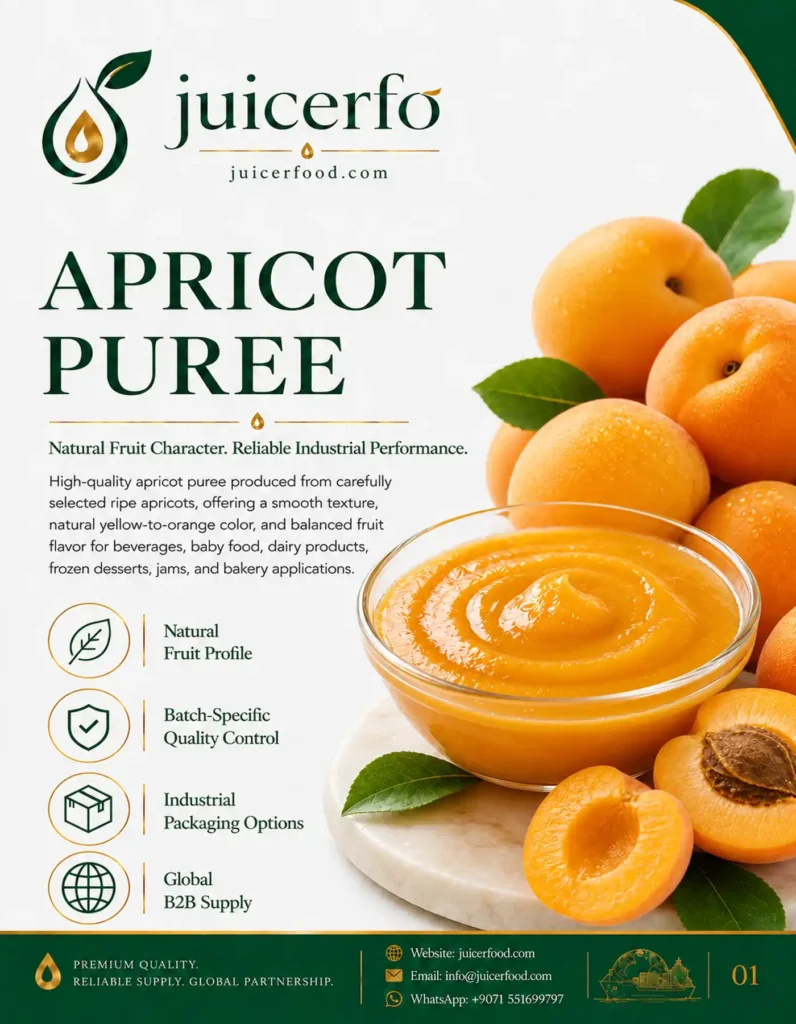
High-quality apricot puree produced from carefully selected ripe apricots, offering a smooth texture, natural yellow-to-orange color, and balanced fruit flavor for beverages, baby food, dairy products, frozen desserts, jams, and bakery applications.
Natural Fruit Profile
Batch-Specific Quality Control
Industrial Packaging Options
Global B2B Supply
Application-Focused Specifications

PRODUCT FORMATS
Single-Strength & Concentrated Apricot Puree
APRICOT PUREE OVERVIEW
Natural Fruit Character. Reliable Industrial Performance.
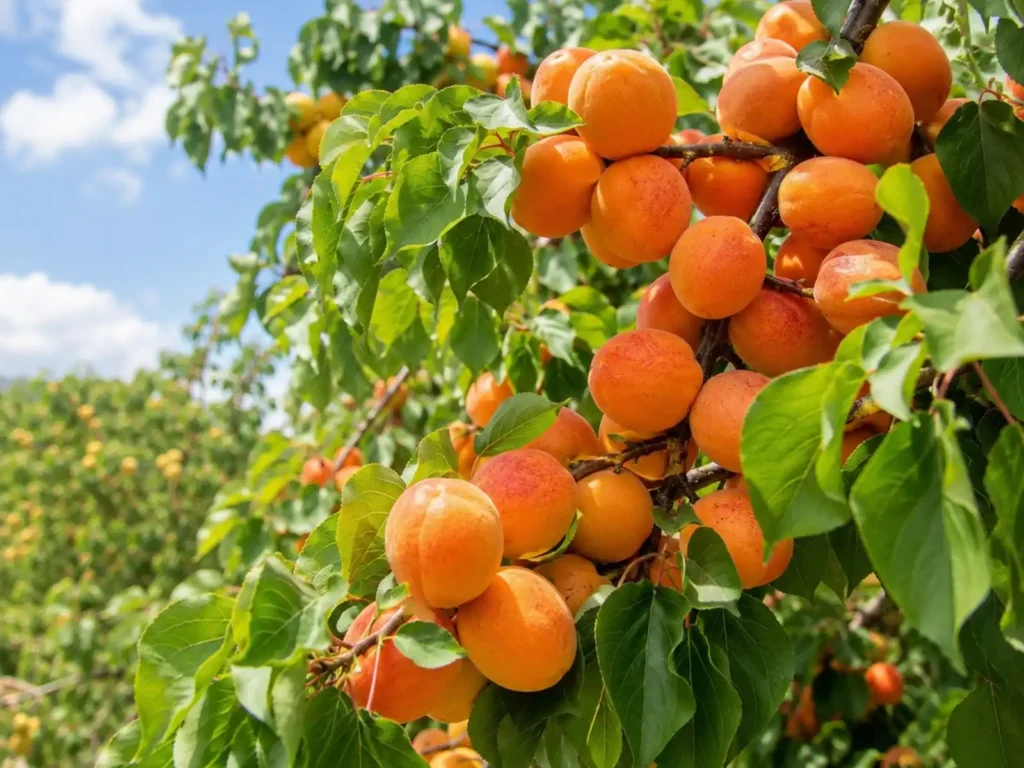
Apricot puree is a versatile industrial fruit ingredient valued for its naturally smooth texture, characteristic apricot aroma, balanced sweet-tart flavor, and attractive yellow-to-orange color. It is produced from ripe apricots through controlled washing, sorting, pitting, crushing, refining, homogenization, pasteurization, and packaging processes designed to preserve the fruit’s natural body and sensory characteristics.
- Smooth and uniform texture with natural apricot pulp and fruit solids.
- Single-strength apricot puree typically available at approximately 10–15°Bx.
- Concentrated apricot puree commonly supplied at approximately 30–32°Bx.
- Natural yellow, amber, or orange color with a characteristic ripe-apricot flavor.
- Suitable for bulk purchasing and export to international food and beverage manufacturers.
Tests & Analysis (Typical Specification)
Tests & Analysis (Typical Specification)
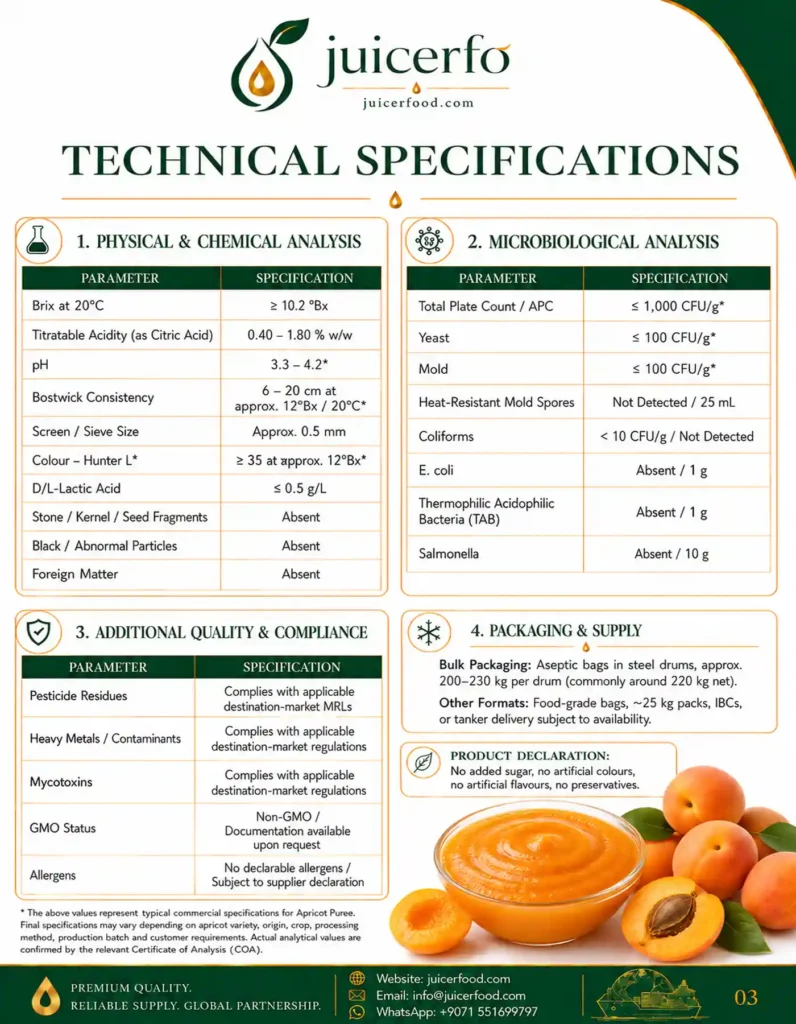
Physical & Chemical Analysis
| Parameter | Specification |
|---|---|
| Brix at 20°C | ≥ 10.2 °Bx |
| Titratable Acidity (as Citric Acid) | 0.40 – 1.80 % w/w |
| pH | 3.3 – 4.2* |
| Bostwick Consistency | 6 – 20 cm at approx. 12°Bx / 20°C* |
| Screen / Sieve Size | Approx. 0.5 mm |
| Colour – Hunter L* | ≥ 35 at approx. 12°Bx* |
| D/L-Lactic Acid | ≤ 0.5 g/L |
| Stone / Kernel / Seed Fragments | Absent |
| Black / Abnormal Particles | Absent |
| Foreign Matter | Absent |
| Total Plate Count / APC | ≤ 1,000 CFU/g* |
| Yeast | ≤ 100 CFU/g* |
| Mold | ≤ 100 CFU/g* |
| Heat-Resistant Mold Spores | Not Detected / 25 mL |
| Coliforms | < 10 CFU/g / Not Detected |
| E. coli | Absent / 1 g |
| Thermophilic Acidophilic Bacteria (TAB) | Absent / 1 g |
| Salmonella | Absent / 10 g |
| Pesticide Residues | Complies with applicable destination-market MRLs |
| Heavy Metals / Contaminants | Complies with applicable destination-market regulations |
| Mycotoxins | Complies with applicable destination-market regulations |
| GMO Status | Non-GMO / Documentation available upon request |
| Allergens | No declarable allergens / Subject to supplier declaration |
| Added Sugar | Not Added |
| Artificial Colours | Not Added |
| Artificial Flavours | Not Added |
| Preservatives | Not Added |
| Appearance | Smooth, homogeneous fruit puree with characteristic apricot consistency |
| Colour | Characteristic natural yellow-orange to orange apricot colour, without abnormal browning or darkening |
| Aroma | Characteristic natural apricot aroma |
| Taste | Characteristic natural, fruity, sweet-tart apricot taste |
| Fermented / Overheated Flavour | Absent |
| Metallic / Foreign / Off-Flavour & Odour | Absent |
* The above values represent typical commercial specifications for Apricot Puree. Final specifications may vary depending on apricot variety, origin, crop, processing method, production batch and customer requirements. Actual analytical values are confirmed by the corresponding Certificate of Analysis (COA).
Apricot Puree Technical Catalog
Apricot Puree Technical Catalog
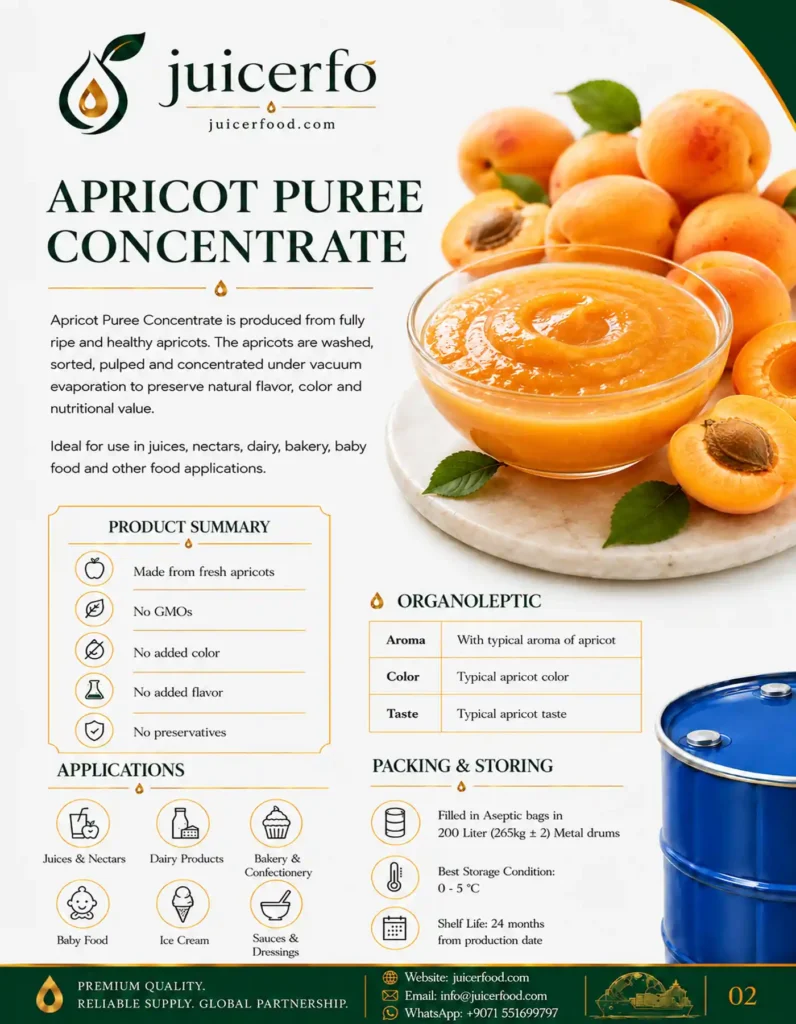
Download the apricot puree catalog to review typical Brix ranges, physicochemical parameters, industrial applications, packaging formats, storage considerations, and essential purchasing documentation for bulk and export orders.
Download Apricot Puree CatalogPDFTap a page to turn it. Use the zoom button to read the page at full size.
SOURCE APRICOT PUREE WITH CONFIDENCE
Looking for a Reliable Bulk Apricot Puree Supplier?
Our team is ready to support your business with the Tell Juicerfo your required Brix, product type, packaging format, order quantity, destination country, final application, and laboratory-testing requirements. Our team will evaluate your inquiry and prepare a suitable technical and commercial proposal for single-strength, concentrated, aseptic, or frozen apricot puree, subject to availability and the agreed specification.best quality and service.
Request an Apricot Puree Quote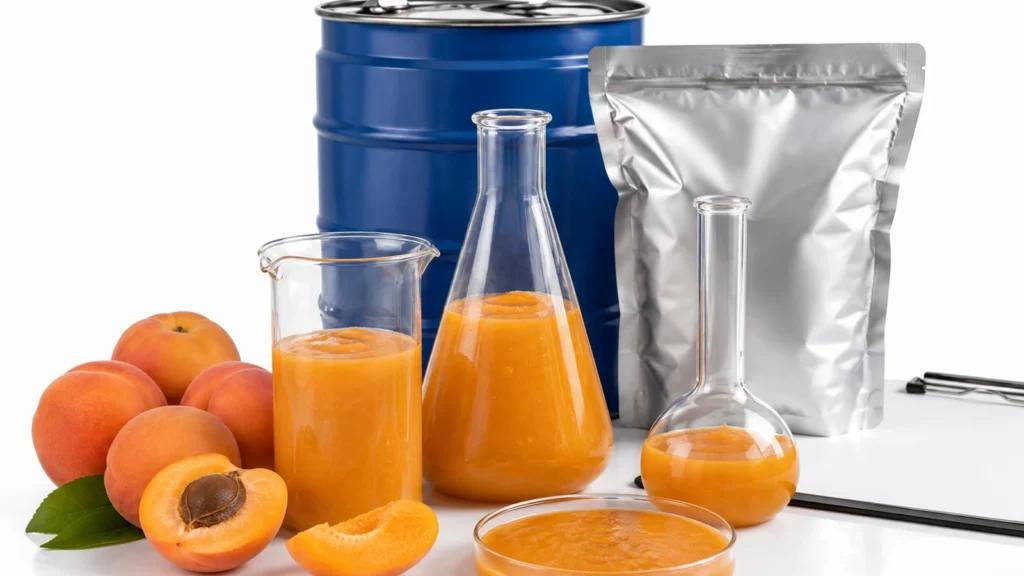
Bulk Apricot Puree Packaging Solutions
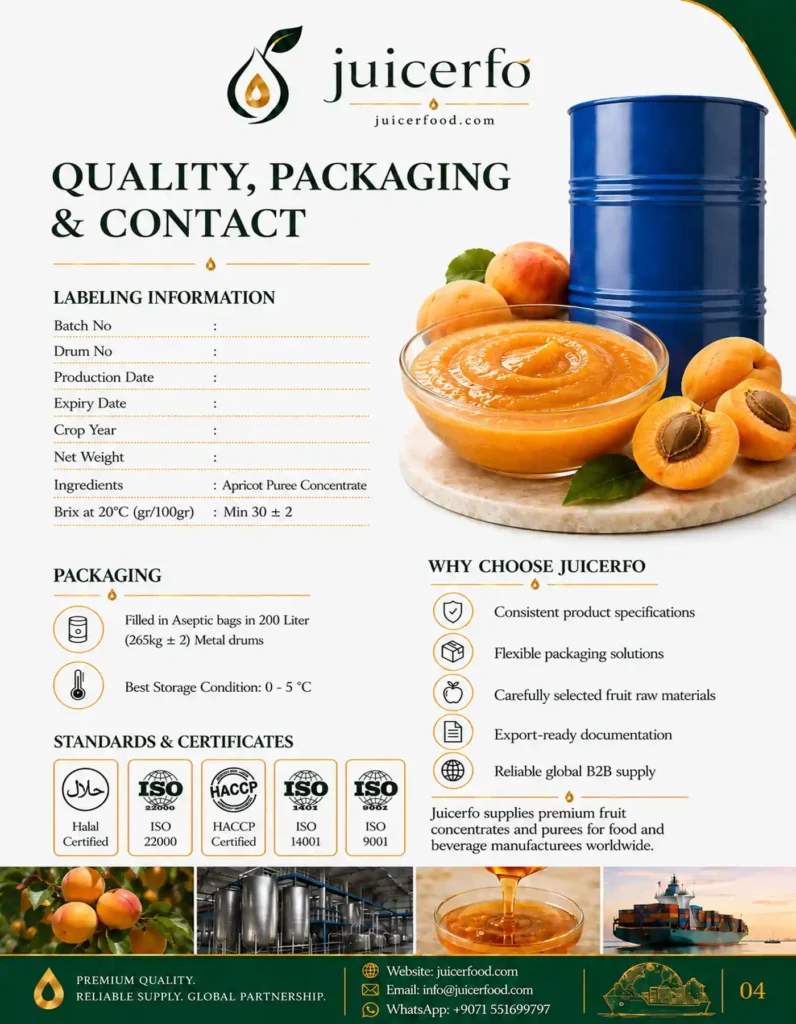
- Aseptic Bag in Steel DrumA widely used packaging format for bulk apricot puree exports. Commercial steel drums generally contain approximately 200–230 kg of product, with some specifications indicating around 220 kg net weight per drum. Final drum weight depends on product density and the selected packaging system.
- Custom Industrial Bulk FormatsDepending on product type, order volume, and supplier availability, concentrated apricot puree may also be offered in food-grade bags, approximately 25 kg packages, large drums, intermediate bulk containers, or tanker delivery. Availability must be confirmed before ordering.

Documented Quality for Industrial Apricot Puree
Batch-Specific COATechnical Data SheetMicrobiological ControlResidue CompliancePackaging Integrity
Apricot puree quality is evaluated through key physicochemical, sensory, microbiological, and regulatory parameters. Depending on the agreed specification, buyers may review Brix, pH, titratable acidity, consistency, particle size, yeast and mold, total plate count, coliforms, pesticide residues, heavy metals, packaging integrity, and traceability records. Final product acceptance should be based on the Technical Data Sheet and batch-specific Certificate of Analysis.
Frequently Asked Questions About Apricot Puree
Single-strength apricot puree commonly has a soluble solids content of approximately 10.2–15°Bx. Concentrated apricot puree is often supplied at approximately 30–32°Bx. Because natural fruit characteristics vary by variety, origin, maturity, and harvest season, the exact Brix should be confirmed in the batch-specific Certificate of Analysis.
Pure apricot puree can be manufactured without added sugar. However, some commercial products may contain a controlled amount of ascorbic acid or another permitted ingredient to support color protection or processing. Buyers should verify the complete composition through the Technical Data Sheet and ingredient declaration.
Single-strength apricot puree retains most of the fruit’s naturally occurring water and generally offers a Brix close to fresh ripe apricots. Concentrated apricot puree is produced by physically removing part of this water, resulting in higher fruit solids, reduced transportation volume, and more efficient storage. Concentrated puree may require reconstitution or formulation adjustment before use.
Bulk apricot puree is commonly packed in aseptic bags inside steel drums containing approximately 200–230 kg, with some specifications indicating around 220 kg net weight. Smaller aseptic cartons of approximately 20 kg may also be available. Frozen containers, food-grade bags, IBCs, and other industrial formats may be offered subject to product specification and availability.
Yes. Apricot puree is widely used in single-fruit and blended baby-food formulations because of its smooth texture and balanced fruit flavor. However, puree intended for infant and young-child products should meet stricter requirements for pesticide residues, heavy metals, microbiological quality, composition, packaging integrity, and traceability in the destination market.
Industrial buyers should request a Technical Data Sheet, batch-specific Certificate of Analysis, Brix, pH, acidity and consistency results, particle-size specifications, microbiological test results, ingredient and allergen declarations, origin information, packaging details, shelf-life conditions, and traceability records. Pesticide-residue and heavy-metal reports may also be required depending on the destination market and final application.